

Charting New Horizons in Alaska’s Maritime Careers
Earlier this month, twelve Alaska students traveled to Seward to earn their maritime credentials and explore real career pathways in one of the state’s most vital industries. Over four busy days, they gained technical skills, confidence, and a deeper connection to Alaska’s maritime community.
Welcomed by UAF’s George Reising and AWA Coordinator Jamie Trapp, students kicked off the trip by submitting their TWIC paperwork—an exciting step toward their merchant marine credentials. They then toured the Alutiiq Pride Marine Institute, learning how shellfish hatcheries operate and even handling a live geoduck.
Seward High graduate Ali Toloff offered a tour of the Hydroponic Connex, while retired bosun Pete Toloff shared stories from decades on the Alaska Marine Highway, emphasizing teamwork as the heart of maritime work. “We don’t need know-it-all’s. We need people who can consistently do their work and get along well with others even during challenging times.”
Students explored career pathways ranging from engine repair to food handling, with several earning their food handler cards—including Kaitlyn from Wrangell, who confidently took omelet orders for the group.
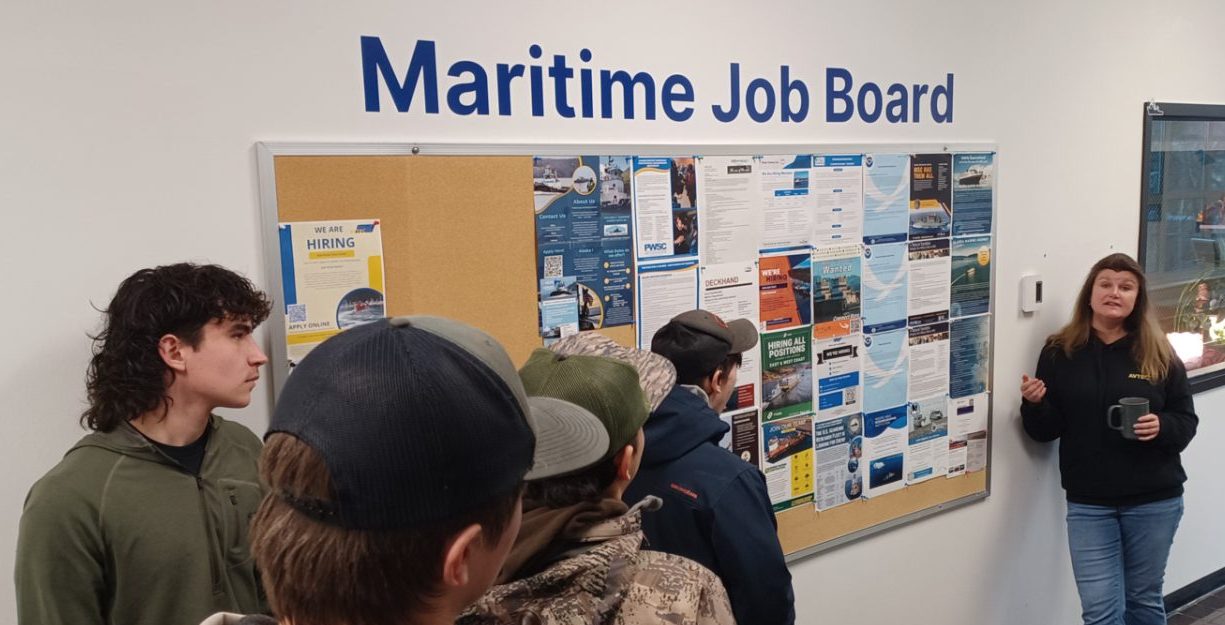
At AVTEC’s Maritime Training Center, Department Head Kari Anderson guided students through ship simulators, navigational labs, diesel and electrical shops, and job boards brimming with opportunities—helping many imagine a future in Seward. “I have even been tempted to remove postings from the board for jobs that I was interested in during the summer when session is not in!” shared Ms. Anderson. “Opportunities abound for those who are interested and have the credentials.”
The group also visited the UAF Seward Marine Center, where Captain Brian Mullaly and marine technicians introduced them to ocean research tools like buoys, ROVs, and gliders. Under Lydia Sgouros’ guidance, students like Katy Reiser from Kodiak, practiced using ROVs to retrieve underwater sensors suspended in the water column. The marine science learning continued into the evening as the students were taken to a protected shoreline for night tidepooling—a highlight for many.
Their final day included a tour aboard the R/V Nanuq and a behind-the-scenes look at Catalyst Marine and the JAG Alaska Shipyard, where they saw barge work, ship repair, and boat building up close. The M/V Aurora, sister ship to the M/V Tustemena, was in the shipyard for maintenance, and students met with a recent graduate from AVTEC’s welding program who was working on repairs.
By the end of the four-day journey, students left Seward with credentials, new skills, and a clearer sense of where they fit in Alaska’s growing maritime workforce—ready to step into a world of opportunity on the water.